

Our Dance Programs
IN THIS LESSON
International Standard — Elegance & Movement
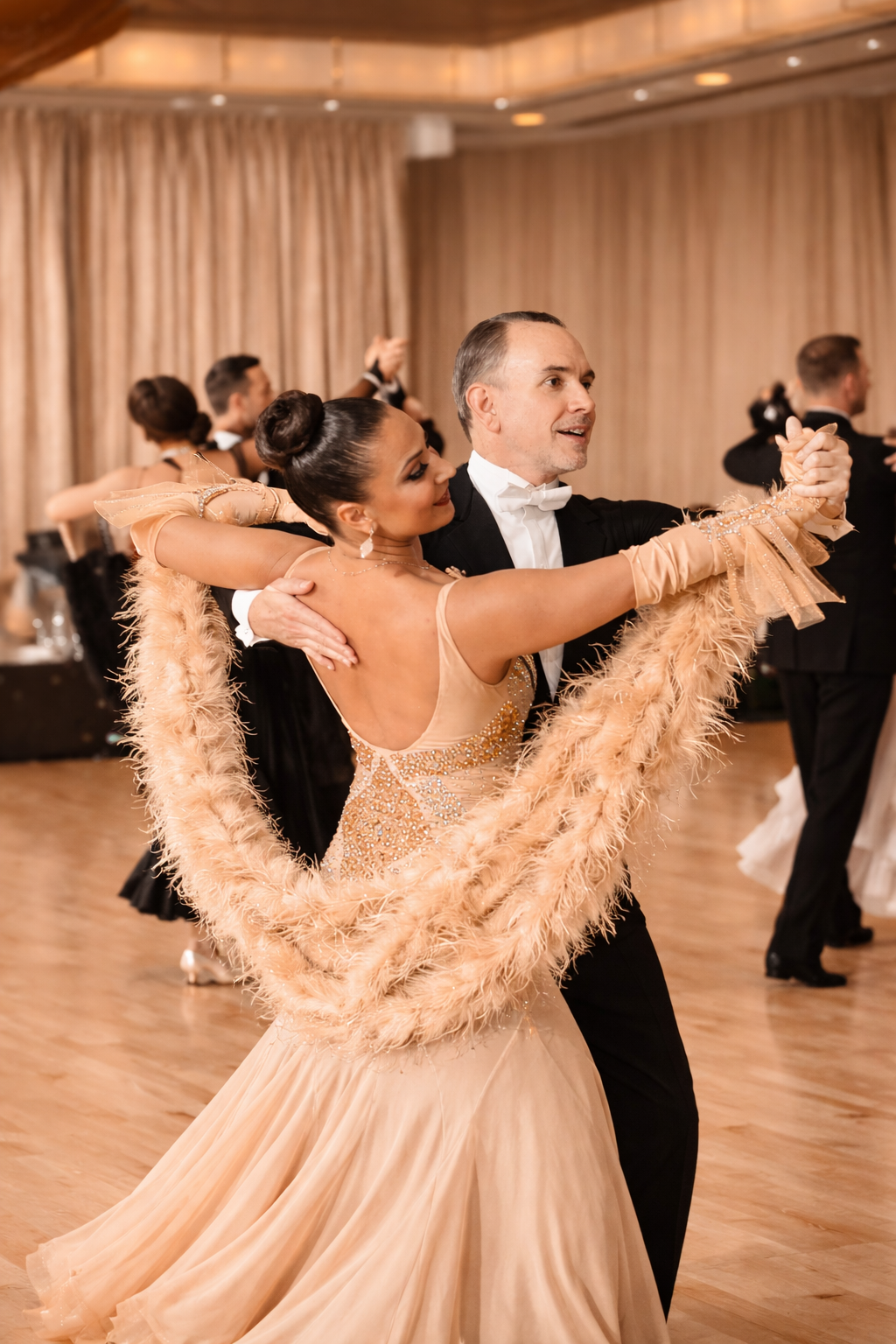
Step into the elegance of International Standard and learn how to move smoothly with a partner, improve posture, and feel confident on the dance floor. These skills are perfect for formal events, social dances, and special occasions where you want to feel comfortable and look polished.
-
The Slow Waltz evolved from the faster Viennese Waltz in 19th-century Europe, as music began to slow down and allowed dancers to move with greater control, expression, and elegance.
In the early 20th century, particularly in England, this slower style was refined and structured into a distinct dance. By the 1920s, it was formally standardized by organizations such as the Imperial Society of Teachers of Dancing, shaping the technique, timing, and syllabus still used today.
The result is a dance defined by smooth rise and fall, flowing movement, and a strong emphasis on musical expression—making the Slow Waltz a cornerstone of International Standard ballroom worldwide.
-
The Tango originated in the late 19th century in the working-class neighborhoods of Buenos Aires, where European, African, and Latin influences blended into a unique and expressive dance style. Initially bold and intimate, it quickly gained popularity and spread to Europe in the early 20th century.
When Tango reached England, it was refined and adapted into a more structured form suitable for ballroom. By the 1920s, it was standardized by organizations such as the Imperial Society of Teachers of Dancing, becoming part of the International Standard style.
Unlike its Argentine roots, International Tango developed a distinct character—sharp, staccato movements, strong body control, and dramatic expression. It emphasizes precise footwork, grounded movement, and clear lead-and-follow technique.
Today, Tango remains one of the most powerful and dramatic dances in ballroom, known for its intensity, contrast, and unmistakable style.
-
The Viennese Waltz is one of the oldest ballroom dances, originating in 18th-century Europe, particularly in Vienna. It evolved from early folk dances and became a defining feature of European ballrooms, known for its fast tempo and continuous turning movement.
As ballroom dancing developed, the Viennese Waltz was refined and later standardized in England by organizations such as the Imperial Society of Teachers of Dancing, becoming part of the International Standard style.
What sets the International Standard Viennese Waltz apart is its focus on:
Continuous rotation with minimal stopping
Faster tempo compared to the Slow Waltz
Simpler figure structure with high technical demand
Strong emphasis on timing, control, and endurance
Unlike the Slow Waltz, which allows for expressive rise and fall and varied choreography, the Viennese Waltz is more uniform and driven by momentum and flow. The challenge lies not in complexity of steps, but in maintaining consistency, precision, and elegance at speed.
Today, it remains a cornerstone of International Standard ballroom, recognized for its timeless elegance, sweeping movement, and demanding technique.
-
The Foxtrot began in the early 20th century in the United States, where a new style of music—ragtime and early jazz—started to shape the way people moved. Inspired by simple walking steps and natural rhythm, the dance quickly grew in popularity for its smooth, effortless feel.
As the Foxtrot made its way to England, it was transformed. What began as a social dance was refined by ballroom experts and formally structured by organizations like the Imperial Society of Teachers of Dancing. Over time, it evolved into the International Standard Foxtrot—a dance defined by control, elegance, and precision.
Often described as the “dance of smoothness,” the Foxtrot is known for its continuous, flowing movement across the floor, blending slow and quick steps with subtle rise and fall. Unlike the more expressive American Smooth, which allows open movements and separation, the International Standard style remains in closed hold, emphasizing connection, timing, and refined technique.
Today, the Foxtrot represents a perfect balance between simplicity and sophistication—where every step appears effortless, yet requires a high level of skill, musicality, and control.
-
The Quickstep originated in the 1920s in the United States, during the rise of jazz and big band music. It developed from a combination of faster Foxtrot rhythms along with influences from dances like the Charleston, bringing a lively and energetic character to the ballroom.
As it moved to England, the Quickstep was refined and structured into a distinct dance within the International Standard style. Ballroom organizations such as the Imperial Society of Teachers of Dancing formalized its technique, transforming it into the light, fast, and highly controlled dance we see today.
Known for its speed and playful nature, the Quickstep is characterized by:
Light, quick footwork
Skipping, hopping, and running actions
Continuous movement around the floor
A combination of strong technique with a carefree, joyful appearance
Unlike the Foxtrot, which emphasizes smooth and grounded movement, the Quickstep feels almost weightless—requiring precision, timing, and excellent coordination to maintain clarity at high speed.
Today, the Quickstep is one of the most exciting dances in International Standard, combining technical discipline with energy and musicality, creating a performance that feels both elegant and full of life.